Erika Medveczky OLY
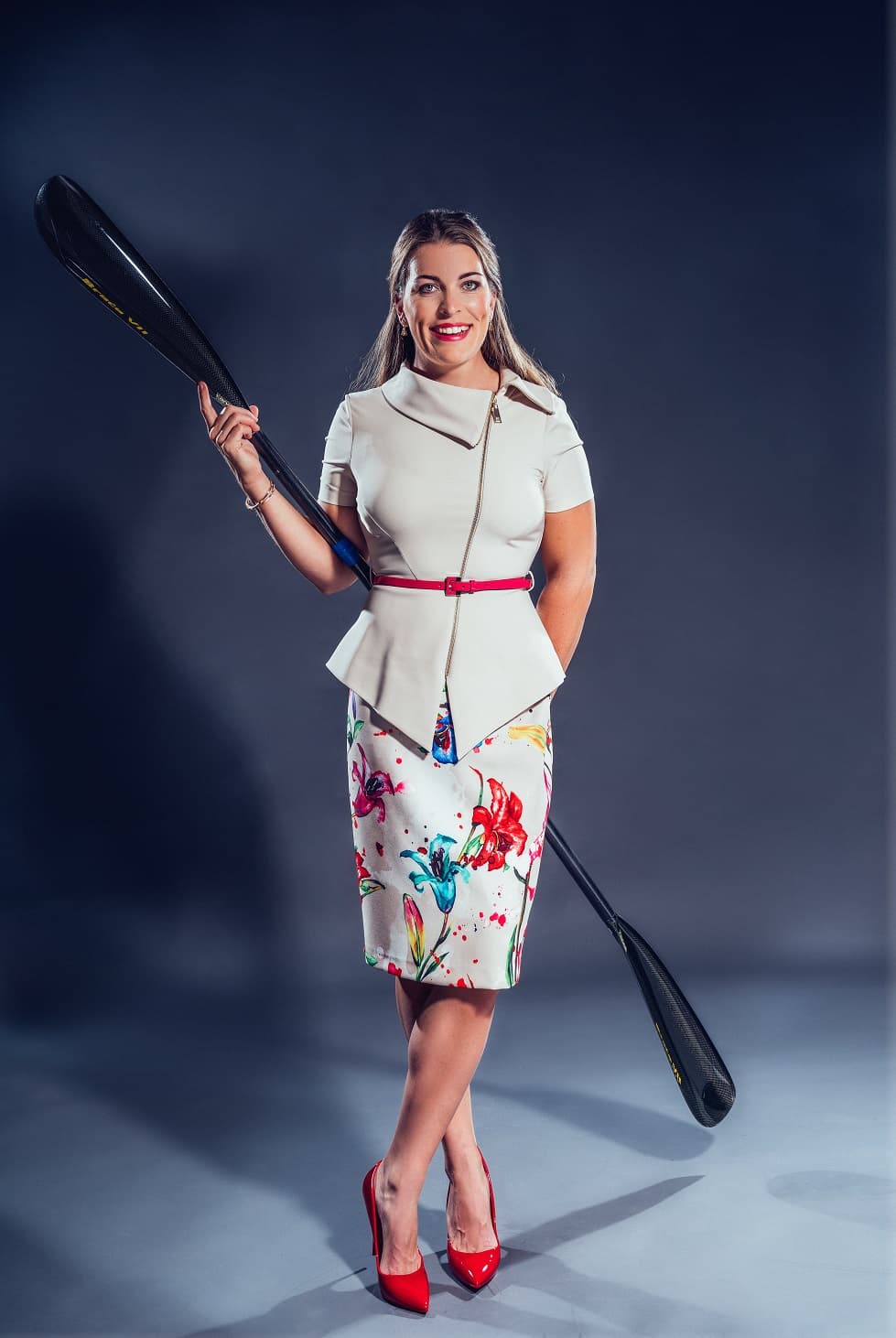
Today, I no longer define myself as a kayak racer, but as Erika Medveczky, someone who wants to use her own path, struggles and victories for the benefit of others. I believe I will never fully take off the competitive mentality, and I do not want to either, because it made me who I am today.
When I was an eight-year-old little girl and saw a kayaking flyer on the school noticeboard, I could not have known that those few moments would define my entire life and lead me all the way to the Olympic Games. But that is exactly what happened. Today, 29 years later, I can say that I owe everything to those years: successes, failures, a lot of learning, travels, countless experiences, friends, mentors and important relationships.
My sports career was not a linear progression. I would much rather compare it to a roller coaster. There were outstanding, loud successes, but just as many low points, and from each of them I was able to stand up again, always learning something and becoming a little stronger. At 18, for example, as a two-time junior European champion, I stopped kayaking for almost half a year. I had a conflict with my coach at the time, and I decided I would not continue. But I missed kayaking so much from my everyday life, the environment, the water, the whole world, that I went back.
After that, there were two more very deep points when I was physically, mentally and, not least, financially exhausted, sitting at home with no idea where to go next. But somehow there was always a push, a hand, a spark that was still inside me and brought me back to the racecourse. During those times, I never looked at distant goals. I could not really even imagine distant goals. All I had in me was to get through the day in front of me. The small steps led me. And then, suddenly, I found myself back on the water and back on the racecourse.
Two very important milestones stand out in my career, both coming after the low points I mentioned earlier. One of them was my first world championship title in 2013 in Duisburg. I finally arrived where I had always wanted to be, on the top of the world championship podium. It was a huge fight to get there, both on the racecourse and inside my own head.
The other was in 2017, when I won the Hungarian selection race in K-1 500 m. That was a moment when the real question was whether I could continue racing or whether I would have to look for another profession. It was a difficult period from every point of view, and my husband and I both knew that it was a turning point. But I did not quit, even though many times it would have been easier. Eventually, I found myself in an environment where I received the support and inspiration I needed in order to surpass myself. Many times throughout my career, my instincts, life itself, and the few but important forms of support I received eventually took me where I needed to be.
In numbers, during my senior career I became an Olympic 4th-place finisher, won 8 world championship gold medals and 3 world championship bronze medals, 6 European championship gold medals, 4 silver medals and 1 bronze medal, and I became a 21-time Hungarian champion. In addition to these, I collected countless finalist placements.
But these are only the numbers and the medals, the tip of the iceberg. The 1 minute 30 seconds, or maximum 4 minutes. That is what everyone sees. But behind all of this is the real essence: how I got there. These results shaped me because I had already fought with myself on the road leading to them. If I had wanted to start there, it would not have worked. Behind all of this are the dark winter Monday mornings when you have to jump into the cold pool to swim, or go out to run, and row 30 kilometers in March with blistered hands.
It is obvious that sport also shaped me as a person. I had always been a fighter, but in elite sport I became truly strong and defined in my character. There was a lot of struggle in this, many tears, weakness and disappointment, but throughout it all I was able to keep my sensitivity. And the long years, the work and the results helped me find my own voice. After a certain point, that voice no longer spoke only for me, but could also speak for others.
That is how, while I was still an active athlete, I became a member of the board of the Hungarian Canoe Federation, the chair of the Athletes' Committee, and also the president of my home club, Kis-Duna SE. These positions gave me a completely different perspective on sport and on other areas of life as well. But everything I had fought through in sport, in everyday life, also became useful to me there. It gave a platform to my ability to stand up for causes or people whose voices did not reach the decision-making tables as strongly.
Being the president of my home club was an especially defining experience. As a child, I had already watched the work of the president at the time, and even then I had the thought that one day I would like to give back in the same way. When I was asked in 2020 to become the president of the club, I threw myself into the work with full energy and enthusiasm.
I learned a great deal, whether it was financial accounting, writing applications and grants, or employer responsibility. These were all things I had not dealt with before, but they also added a lot to my ability to transition more successfully from being an athlete into the more everyday world. I became even more grown-up, and I experienced what it is like to support the professional work of others and achieve success together. I was able to help athletes who were only just beginning to spread their wings, while we were also able to keep the personal, family-like environment that had always characterized the club.
Since I have not been actively competing, and my own performance is no longer at the center of my everyday life, a certain kind of attention and energy has been freed up in me, the same kind that used to drive me forward every day. Now the time has come for me to pass on to others the knowledge, experience and life material that I have gathered over 29 years in the world of kayaking and elite sport.
It has always been important to me to give back to the environment I received so much from. The sports community, the coaches, the leaders and the people around me shaped my entire life. Now I would like to become a similar mentor for those who need it.
Today I live and work in Gainesville, in the state of Georgia in the United States, as a head coach with athletes between the ages of 13 and 17. My goal is to give them not only technical knowledge, but also mental foundations. I want them to become more conscious and to learn that there is no fast success. What is truly valuable has to be worked for over the long term. These are the foundations I also received from my first coach, and they are the ones I still build on today, as a person too. Alongside successful athletes, I also want to raise good people.
I enjoy working with beginners because there is so much that can be taught to them. But I also see the challenge in working with professionals, with people who feel unsure about what the next step should be, in finding what is blocking them and what could help move them forward. I am also happy to help coaches, because I know the world of sport from several different sides, and I know what qualities make someone a truly good coach, the kind of coach I am also trying to become. Although I deeply believe that everyone has to find what is perfect for themselves.
For me, this platform is not self-expression, but an opportunity. I believe that the experiences that shaped me can also give others something to hold on to. Yes, I do have fear around being visible, but I have always been more drawn to a challenge than held back by fear. Sometimes I like jumping into the deep end.
This is one of those jumps.
And if I had to summarize what I believe in one sentence:
"Your choice, your chance."
This has followed me throughout my life. Our decisions shape us. And there is always a new chance, if we are ready to take the step.